The "Lyckopenning" - a gift tradition since 1912
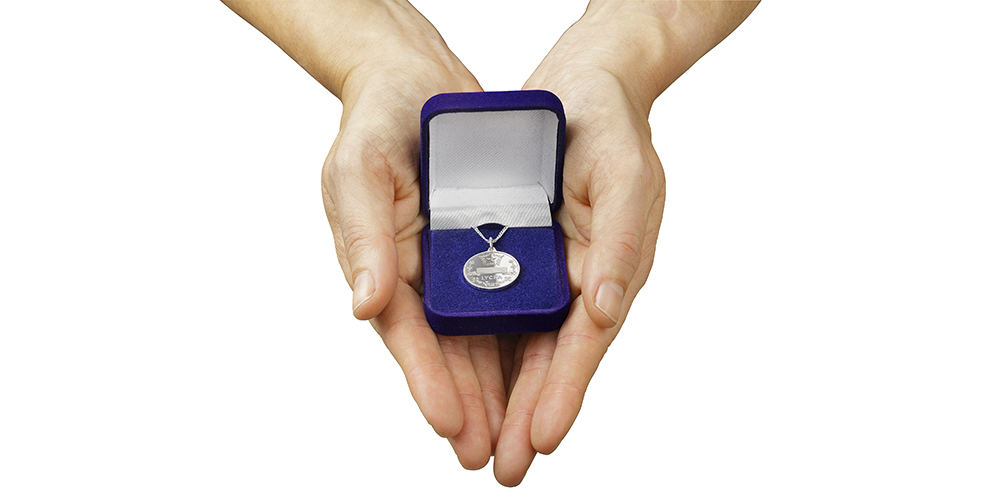
At the same time as the "Lyckopenning" is an appreciated gift, it is a contribution to the work of the Visually Impaired National Association. Ever since 1912, the "Lyckopenning" has been a popular gift, both to give and to receive.
There was a postmaster named Holbøll, who at the beginning of the 20th century suffered from an eye disease that made him temporarily blind. Meanwhile, he heard about the birth of a child and is said to have wished that all children would be spared from what he had been through.
Postmaster Holbøll regained his sight, but he never forgot the strong experience he had of being blind and the difficulties it entailed. He therefore wanted to try to help the blind organization with something that could help them spread information about the difficulties of being blind.
He then thought again of the child he had heard of when he was blind, and said to himself "When but at the cradle of the child do you bestow a thought of happiness and prosperity in life?" He wrote to the association for the blind and gave the idea of a lucky charm to be sold by the association to new parents.
De Blindas Förening in Sweden adopted the idea on 18 October 1912 and sales began immediately. In the first year, approximately SEK 10,000 came in from sales, which corresponds to roughly half a million in today's monetary value. The money was divided so that 4/5 went to De Blindas Förening and 1/5 to the Midwives' support fund for their help in selling the "Lyckopenning" at BB. Even today, Lyckopenningen supports the midwives by awarding scholarships for further education and research in infant care; here you can read examples of what Lyckopenningen has supported.
And even 100 years after its inception, the income from the "Lyckopenning" is an important contribution to the work of the Visually Impaired National Association for the visually impaired to have a better life in society.
The idea of Lyckopenningen thus has exactly the same relevance today 100 years later. It is a precious gift with a priceless meaning! And for the National Federation of the Visually Impaired, it provides an important financial contribution in our fight to give the visually impaired equality and full participation in our society.
The lucky charm is handed down from generation to generation and now you too can carry this fine tradition on.